Thursday, November 19, 2009

The Exorcist

I recently prowled upon 'Possessed' by Thomas Allen and I hit google again for some research of my own and found the below interesting pertaining to 'The Exorcist'.

The book below isnt worth much because its a collection of short stories...it only mentions the true story. For the real thing, read 'Possessed' by Thomas Allen.

I wondered for a long time,

'Did 'The Exorcist' actually happen?'

'Was it real?'

'Was it based on a true story?'

I just happened to visit Lifeline in Liverpool and chanced upon this book (as naturally as my eyes dart towards any book with the word 'possession' in its title). And couldnt believe my luck that I found the whole story to be inspired by real events. It DID happen.

The best part is the books good. Real good. Not like 'The devil in Angela' by Alex Snobel. Ive yet to read 'Possession' by Peter James, which is most likely fiction based. The most interesting fact that revolves around these true stories is that the victims most always have dabbled in the occult. In both cases the little boy and the woman tried the ouija board many times. In the boys case, it was his own aunt (who was a Spiritualist) who introduced him to it. That sucks!

A tv show was made based on the book:

A made-for-television film entitled Possessed was broadcast on Showtime on October 22, 2000. It claimed to follow the true accounts that inspired Blatty to write The Exorcist. It was directed by Steven E. de Souza and written by de Souza and Michael Lazarou, from the book of the same name by Thomas B. Allen. Main characters were played by Timothy Dalton, Henry Czerny and Christopher Plummer.


Apparently there was a sequel to Blattys book:

"  Blatty directed The Ninth Configuration, a post-Vietnam War drama set in a mental institution. Released in 1980, it was based on Blatty's novel of the same name. Though it contrasts sharply with the tone of The Exorcist, Blatty regards Configuration as its true sequel. The lead character is the astronaut from Chris' party, Lt. Cutshaw. "

 The Ninth Configuration, (also known as Twinkle, Twinkle, "Killer" Kane

The Ninth Configuration
Theatrical release poster

The first half of the film has the predominant tone and style of a comic farce. In the second half, the film becomes darker as it delves deeper into its central issues of human suffering, sacrifice and faith. The film also frequently blurs the line between the sane and the insane.


Synopsis

Colonel Kane (Stacy Keach), a Marine psychiatrist suffering from nightmares, arrives at a castle in the American Pacific Northwest where shell-shocked and insane soldiers from the Vietnam war are being treated. The castle's staff has been unable to control the patients, many of whom are suspected of faking their illness to get out of combat. The permissive Kane opens himself up to listen to anything the soldiers have to say to him in an effort to heal them, while at the same time suffering from his own demons.

William Peter Blatty once referred to The Ninth Configuration as the true sequel to The Exorcist, and has stated that he intended the character of Captain Cutshaw to be the same astronaut whom a sleepwalking Regan in The Exorcist warns, "You're going to die up there." In The Ninth Configuration, Cutshaw mentions a fear of dying in space that is almost certainly a reference to Regan's line in the previous film. However, the characters were played by different actors, and the astronaut in The Exorcist is not given a name onscreen or by the credits.
Although The Ninth Configuration is quite dissimilar to The Exorcist in terms of story and tone, both films feature theological discussions between their respective characters which address questions of faith, the mystery of goodness vs evil, and the existence of God and the Devil. The motif of a saint's medallion as a symbol of faith appears in both The Exorcist and The Ninth Configuration; also of interest is the fact that some dialogue from Blatty's discarded, first-draft screenplay for The Exorcist was re-used in The Ninth Configuration.
From the original Exorcist screenplay:
Chris MacNeil: If you're asking if I believe in the devil, the answer is yes - yeah, that I believe. The devil keeps doing commercials.
Father Dyer: But if all the evil in the world makes you think that there might be a devil - then how do you account for all of the good?
From the final version of The Ninth Configuration:
Captain Cutshaw: I believe in the Devil alright. And you know why? Because the prick keeps doing commercials!
and
Colonel Kane: You're convinced that God is dead because there's evil in the world.
Captain Cutshaw: Correct.
Colonel Kane: Then why don't you think He's alive because of the goodness in the world?


'The Exorcist' Movie trivia:

- The bedroom set had to be refrigerated to capture the authentic icy breath of the actors in the exorcizing scenes, the bedroom scenes along with many other scenes were filmed in the basement of Fordham University in New York. The temperature was brought so low that a thin layer of snow fell onto the set one morning. Linda Blair, who was only in a thin nightgown, says to this day she cannot stand being cold.

- The movie's eerie opening sequence was filmed in the Iraqi town of Sinjar, near the Syrian border. The people of Sinjar are mostly Kurdish members of the ancient Yezidi sect, which worships a deity often equated with the Devil.[5] The archaeological dig site seen at the beginning of the movie is the actual site of ancient Nineveh in Hatra.


Blattys actually going to re-make 'The Exorcist' into a mini series:

"In November 2009 was announced that William Peter Blatty planned a miniseries of his film"

Urban legends and on-set incidents

Some claim the film was cursed. Blatty has stated on video[7] some strange occurrences. Burstyn indicated some rumors to be true in her 2006 autobiography Lessons in Becoming Myself. The interior sets of the MacNeil residence, except for Regan's bedroom, were destroyed by a studio fire and had to be rebuilt. Friedkin has claimed that a priest was brought in numerous times to bless the set. Other issues include Blair's harness breaking when she is thrashing on the bed, injuring the actress. Burstyn noted she was slightly hurt when Regan throws her across the room. Actor Jack MacGowran (Burke Dennings) died during filming.


realstorybehindexorcistcover

The book revolves around a reporter trying to track down the real person upon which the movie The Exorcist was based, and discovers that there was more to the story. During the investigation, different tales are told by “witnesses” from their perspective that lead the reporter to the real-life inspiration.
Interestingly, the studio plans to ignore the actual newspaper articles that exist in relation to the case.


Parallel Imagery


In the Iraq opening, a young boy runs across the diggings to get a message to Father Merrin. The camera peers through his legs as he speaks, foreshadowing the gruesome crucifix masturbation scene that comes later.


In Iraq, Father Merrin finds the small amulet in his diggings and senses evil, much like Lieutenant Kinderman does when he finds one of Regan’s clay creations at the bottom of the Washington steps, where two deaths occur.


This one is pretty self explanatory. In the Iraq opening again, a steel worker removes his hat and gazes over to Father Merrin, revealing a blank, white eye. Of course, Regan’s eyes will later resemble this in her demonic state.


Ever noticed that Regan’s creation kind of looks like the Pazuzu statue from the Iraq scenes? Pazuzu is the demon that possess young Regan, using the name Captain Howdy. Regan’s ‘art’ can also be associated with the desecration of the Mary statue in the church.


In the Iraq opening, Father Merrin is examining some findings when the clock behind him stops. This same clock appears (for a second) during Father Karras’ dream after his mother dies. The two characters don’t meet until the end part of the film, but the image of the stopped clock brings them fatefully together for the viewers.


This is one of my favorites. Chris is woken early in the morning to start shooting and rolls over to find Regan has snuck into bed with her. While Chris is on the phone, we clearly see a picture frame on her bedside dresser with a photo of Regan inside. Later, during the hypnotism, Chris stands in front of the photograph (which is blurred out in the background) and she is unknowingly holding the same pose. This same pose is also freakishly close to the pose Regan is sitting in after killing Father Merrin near the end of the film.


During Father Karras’ dream, we see a shot of his mother against a pitch black background, almost exactly like the Captain Howdy subliminals that occur during the film. This is a little freaky as later on, during the exorcism, Captain Howdy/Pazuzu will use Karras’ dead mother against him in a bid to break his faith.


"Subliminal Images"

Alleged subliminal imagery

The Exorcist was also at the center of controversy due to its alleged use of subliminal imagery. A detailed article in the July / August 1991 issue of Video Watchdog examined the phenomenon, providing still frames identifying several usages of subliminal "flashing" throughout the film.[30] In an interview from the same issue, Friedkin explained, "I saw subliminal cuts in a number of films before I ever put them in The Exorcist, and I thought it was a very effective storytelling device... The subliminal editing in The Exorcist was done for dramatic effect — to create, achieve, and sustain a kind of dreamlike state."[31] However, these quick, scary flashes have been labeled "[not] truly subliminal"[32] and "quasi-" or "semi-subliminal"[33]. True subliminal imagery must be, by definition, below the threshold of awareness.[34][35][36][37] In an interview in a 1999 book about the movie, The Exorcist author William Blatty addressed the controversy by explaining that, "There are no subliminal images. If you can see it, it's not subliminal."[38]


As fans of the film know, The Exorcist is littered with many clever subliminal images that assist in telling the compelling story. Many different people have different opinions of these subliminal moments and they were definitely a point of controversy when the film was released in 1973.
Here, I have listed all the subliminal images I have found in the latest version of The Exorcist.
The DVD time is relevant to The Version You’ve Never Seen edition.

DVD TIME
IMAGE
0:31:29

SCENE DESCRIPTION:
Regan’s medical examination. Her eyes open wide as she lays on the bed and this image of Captain Howdy flashes up on the screen for three frames.

DVD TIME
IMAGE
0:45:01

SCENE DESCRIPTION:
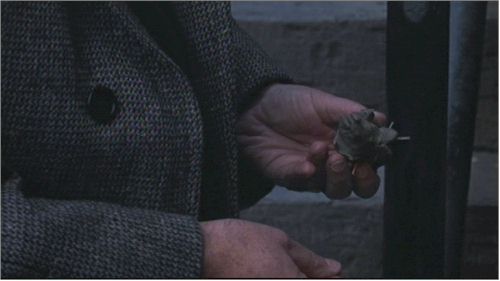
Father Karras’ dream sequence is where the first subliminal appeared in the 1973 original. Also look for many other great images that aid the story including the stopped clock from Iraq and the running dog, representing the dog fight Father Merrin sees when he goes to the Pazuzu statue.

DVD TIME
IMAGE
0:56:03

SCENE DESCRIPTION:
To the right of screen next to Chris’ face in the kitchen. The lights flicker on and Howdy can be seen. One of the most recognized subliminal from The Version You’ve Never Seen.

DVD TIME
IMAGE
0:56:13

SCENE DESCRIPTION:
Chris is about to open the door to Regan’s bedroom. The face of the Pazuzu statue can be seen against the black just before she opens it. It is very quick and bright, so don’t blink or you’ll miss it!

DVD TIME
IMAGE
0:56:56

SCENE DESCRIPTION:
Watch the statue fade into view to the left of screen after Chris leaves Regan’s bedroom the room. It can be hard to see (hence no image), but if you look, you will see Pazuzu!

DVD TIME
IMAGE
1:00:05

SCENE DESCRIPTION:
This cross-fade subliminal was very cleverly added for The Version You’ve Never Seen. When Regan is hypnotized and gets angry, an angry face of Captain Howdy blends in with hers on a close-up.

DVD TIME
IMAGE
1:43:13

SCENE DESCRIPTION:
Regan is being exorcised. The lights are flickering on and off, and Regan is flinging her head from side to side. At one point, when the lights go down and Regan is turning her head to face us, it is Captain Howdy.

DVD TIME
IMAGE
1:45:24

SCENE DESCRIPTION:
Kind of like the hypnotized face. Regan spins her head around during the exorcism and we get a close-up of her face with Captain Howdy’s dissolved in. This helps animate the dummy’s head.

DVD TIME
IMAGE
1:56:23

SCENE DESCRIPTION:
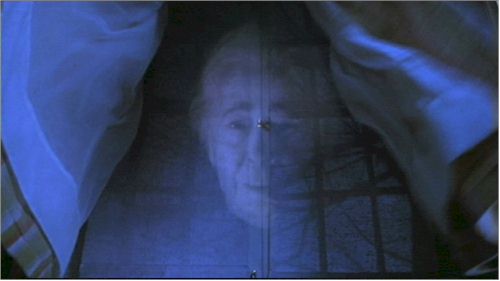
Father Karass demands that Pazuzu enter him. He is possessed and about to jump out the window. There is a shot of the window before he shouts ‘Nooo!” and within the flicker of the curtains, he can see his mothers face.


1.


The Demonologist: The Extraordinary Career of Ed and Lorraine Warren


The Demonologist: The Extraordinary Career of Ed and Lorraine Warren

~ Gerald Brittle
(Author)


Product Description

If you think ghosts are only responsible for hauntings, think again. The Demonologist reveals the grave religious process behind supernatural events and how it can happen to you. Over twenty years in print, here is the original uncut version of this classic text. Illustrated with photographs of phenomena in progress, every sentence in the book is true. Used as a text in seminaries and classrooms, this is one book you canÂ’t put down.

About the Author

For over five decades Ed and Loraine Warren have been considered America?s foremost experts on demonology and exorcism. With over 3,000 investigations to their credit, they reveal what actually breaks the peace in haunted houses. Expertly written by Gerald Daniel Brittle, a nonfiction writer with advanced degrees in literature and psychology specializing in mystical theology.


2.


The Dark Sacrament: True Stories of Modern-Day Demon Possession and Exorcism


The Dark Sacrament: True Stories of Modern-Day Demon Possession and Exorcism

~ David Kiely (Author), Christina Mckenna (Author)


o o o o o o o o o o o o o o o o o o o o o o o o o o o o o o o o o o o o o o o o o o o o o o o o o o o o o o o o o o o o o o o o


Product Description

The Devil Is Alive and Well
In The Dark Sacrament, coauthors David M. Kiely and Christina McKenna faithfully recount ten contemporary cases of demon possession, haunted houses, and exorcisms, and profile the work of two living, active exorcists. The authors serve as trustworthy guides on this suspense-filled journey into the bizarre, offering concrete advice on how to avoid falling prey to the dark side.


About the Author

David M. Kiely's long career as a freelance writer has included biographies, short stories, crime novels, mysteries, and several works of nonfiction. When his spouse and coauthor, Christina McKenna, was eleven, a paranormal "visitor" tormented her home for six weeks. Only through the intervention of an exorcist could the spirit be expelled. The authors live in Rostrevor, Northern Ireland.


3.

Begone Satan


Product Description

This famous little book describes an extraordinary 23-day-long exorcism case in 1928 involving a woman who had been cursed by her own father. It took place in a parish in Earling, Iowa and was assisted by religious sisters, all of whom requested a transfer when the distressing experience was over. The story shows the power of Satan, but more importantly, demonstrates the power of God over Satan, as exercised through the Catholic priesthood and her traditional Rite of Exorcism. The strange noises and repulsive bodily phenomena caused by the devil that are described here exemplify the power of the devil over matter. Conversations between the exorcist and various evil spirits, also recorded here, give insights into the devil's malice and cunning. Yet this account also reveals the fear these evil spirits have of Holy Water, of a Crucifix, of Relics as well as of St Michael the Archangel and various other Saints. One of the most famous exorcism cases in U.S. history, this fascinating yet sobering story reveals the malice of Satan and shows God's victory over him through the instrumentality of His Holy Catholic Church, instilling hope and confidence in the reader of the power of Christ over the devil and his minions.


4. All of Malachi Martins & Jose Antonio Fortes books

Interview With an Exorcist: An Insider's Look at the Devil, Demonic Possession, and the Path to Deliverance5.


Thursday, November 05, 2009

Video / PC Games We Used To Play

PC:
Prince Of Persia
Tetris
Pacman

VIDEO (Pegaus I think):
Contra (my brother and I finished all levels, 8 I think it was)
Mario & Luigi

Best Of Alan Shore & Denny Crane


Boston Legal - boston-legal wallpaper

http://www.popsucker.net/images/popsucker/boston_legal_s2_box.jpg


Bostonlegalinvite


Boston Legal
Judge for yourselves ... the cast of Boston Legal

Flamingoes in Boston Legal


http://www.tvworthwatching.com/werts/boston%20legal%20christmas.jpg


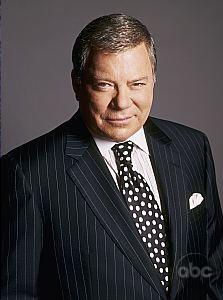
Don't worry: William Shatner, James Spader and Candace Bergen aren't going anywhere. 

James Spader
JAMES SPADER
AND I SHALL NOT HEAR ANYTHING TO THE CONTRARY.
(For reals!   He’s awesome!   He delivers insane closing arguments on Boston Legal!


ALAN SHORE V/S DENNY CRANE:

I’m back on my Boston Legal marathon, and I thought, “Why didn’t I make a comparison between the great Alan Shore and the infallible Denny Crane months ago?”
They’re both lawyers. They’re both rainmakers. They’re both brilliant. And they’re both amusing, and funny, and interesting. They both have voracious sexual appetites. Both have their own mental issues. Both can humiliate you off the court with just their words. And both have “bullseyes on their asses.”
And they’re both flamingoes.
Prone to Word Salad: Alan Shore
He certainly has a way with his words that I think he would be nothing without them. His “word salad dilemma” made that all too clear. His word salad episodes, however, were only for a short while. With his words at his command, he’ll definitely have the jury at his mercy.
Not that his method is intimidating. He just has a way in twisting the thoughts of other people into thinking that cannibalism or shooting a photographer/papparazzi is ethically acceptable. Alan Shore would occasionally cross the line beyond his professional training, however, and resort to illegal means just to help a client. Alan Shore is depicted as a cold and insensitive lawyer, but he has also shown, in great respect, a relevant amount of kindness and care for those around him when he can.
He also has the face, a face that visibly challenges those who he thinks are a good “rattle.” And he’ll rattle you back. With flair. And you could end up liking him for it.
Mad Cow Diseased: Denny Crane
Undisputedly one of the great (fictional) lawyers of all time.. with no losses and a hundred percent victory rate in the courtroom.. it’s Denny Crane.
He’s a crazed one. But he is still unbelievably effective in the courtroom, as Boston Legal has shown time and again. He shocks us a lot with many of his conversations and actions, yet in the end he is still the king of the show (even though the show isn’t all about him).
He’s the funniest one in Boston Legal, I’m sure. Despite his sexual innuendos, he never fails to crack me up with even just a single phrase. Well, two words, in fact: Denny Crane.
Who’s crazier? Denny Crane.
Who’s funnier? Denny Crane.
Who’s more successful? Denny Crane.
But I choose Alan Shore.
While Denny Crane can make me laugh all throughout the series, it is still Alan Shore who gets me interested. His vastly complex character leaves the impression that there are still things he’s hiding. His twisted way of winning a case may be ethically challenging, but then his cases calls for it. And while he has suffered losses and Denny Crane has not, Alan shore surely had more stimulating cases than Denny Crane did.

Adlai Stevenson's ''Nature Of Patriotism'' Speech, 1952


August 27, 1952

We have joined our strength with that of others-and we have done so in self-protection. We seek no dominion over any other nation-and the whole free world knows it! If there are those behind the Iron Curtain who don't know it, it is because their masters don't want them to know it.
I am not sure that, historically, there has been another powerful nation that has been trusted as the United States is trusted today. It is something new under the sun when the proudest nations on earth have not only accepted American leadership in the common defense effort, but have also welcomed our troops and bases on their territory. Ports the world around are open to American warships by day or night. Our airmen are stationed in the most distant lands.
Yet all is not perfect. There are still vital interests which we and our allies are not militarily prepared to defend.
Some of us are reluctant to admit that security cannot be won cheaply by some clever diplomatic maneuver or by propaganda.
We have not yet really faced up to the problem of defending our cities against the rapidly growing threat of Soviet air power. There is, for example, a great shortage of volunteers for our civil defense ground observation corps.
And many only partly understand or are loath to acknowledge that the costs of waging the cold war are but a fraction of the costs of hot war.
So there remain important tasks for us. I believe in a strong national defense, and I believe that we must press forward to improve our position and not waver or hesitate in this interval when the scales are so precariously balanced. While I think it is true that today the fight for preparedness is going well, there are other and even more difficult tasks that we dare not neglect.
The United States has very large power in the world today. And the partner of power-the corollary-is responsibility. It is our high task to use our power with a sure hand and a steady touch-with the self-restraint that goes with confident strength. The purpose of our power must never be lost in the fact of our power-and the purpose, I take it, is the promotion of freedom, justice and peace in the world.
We talk a great deal about patriotism. What do we mean by patriotism in the context of our times? I venture to suggest that what we mean is a sense of national responsibility which will enable America to remain master of her power-to walk with it in serenity and wisdom, with self-respect and the respect to all mankind; a patriotism that puts country ahead of self; a patriotism which is not short, frenzied outbursts of emotion, but the tranquil and steady dedication of a lifetime. The dedication of a lifetime-these are words that are easy to utter, but this is a mighty assignment. For it is often easier to fight for principles than to live up to them.
Patriotism, I have said, means putting country before self. This is no abstract phrase, and unhappily, we find some things in American life today of which we cannot be proud.
Consider the groups who seek to identify their special interests with the general welfare. I find it sobering to think that their pressures might one day be focused on me. I have resisted them before and I hope the Almighty will give me the strength to do so again and again. And I should tell your-my fellow Legionnaires-as I would tell all other organized groups, that I intend to resist pressures from veterans, too, if I think their demands are excessive or in conflict with the public interest, which must always be the paramount interest.
Let me suggest, incidentally, that we are rapidly becoming a nation of veterans. If we were all to claim a special reward for our service, beyond that to which specific disability of sacrifice has created a just claim, who would be left to pay the bill? After all, we are Americans first and veterans second, and the best maximum for any administration is still Jefferson's; ''Equal rights for all, special privileges for none.''
True patriotism, it seems to me, is based on tolerance and a large measure of humility.
There are men among use who use ''patriotism'' as a club for attacking other Americans. What can we say for the self-styled patriot who thinks that a Negro, a Jew, a Catholic, or a Japanese-American is less an American than he? That betrays the deepest article of our faith, the belief in individual liberty and equality which has always been the heart and soul of the American idea.
What can we say for the man who proclaims himself a patriot-and then for political or personal reasons attacks the patriotism of faithful public servants? I give you, as a shocking example, the attacks which have been made on the loyalty and the motives of our great wartime Chief of Staff, General Marshall. To me this is the type of ''patriotism'' which is, in Dr. Johnson's phrase, ''the last refuse of scoundrels.''
The anatomy of patriotism is complex. But surely intolerance and public irresponsibility cannot be cloaked in the shinning armor of rectitude and righteousness. Nor can the denial of the right to hold ideas that are different-the freedom of man to think as he pleases. To strike freedom of the mind with the fist of patriotism is an old and ugly subtlety.
And the freedom of the mind, my friends, has served America well. The vigor of our political life, our capacity for change, our cultural, scientific and industrial achievements, all derive from free inquiry, from the free mind from the imagination, resourcefulness and daring of men who are not afraid of new ideas. Most all of us favors free enterprise for business. Let us also favor free enterprise for the mind. For, in the last analysis, we would fight for the death to protect it. Why is it, then, that we are sometimes slow to detect, or are indifferent to, the dangers that beset it?
Many of the threats to our cherished freedoms in these anxious, troubled times arise, it seems to me, from a healthy apprehension about the communist menace within our country. Communism is abhorrent. It is strangulation of the individual; it is death for the soul. Americans who have surrendered to this misbegotten idol have surrendered their right to our trust. And there can be no secure place for them in our public life.
Yet, as I have said before, we must take care not to burn down the barn to kill the rats. All of us, and especially patriotic organizations of enormous influence like the American Legion, must be vigilant in protecting our birth-right from its too zealous friends while protecting it from its evil enemies.
The tragedy of our day is the climate of fear in which we live, and fear breeds repression. Too often sinister threats to the Bill of Rights, to freedom of the mind, are concealed under the patriotic cloak of anti-communism.
I could add, from any own experience, that it is never necessary to call a man a communist to make political capital. Those of us who have undertaken to practice the ancient but imperfect art of government will always make enough mistakes to keep our critics well supplied with standard ammunition.
There is no need for poison gas.
Another feature of our current scene that I think invites a similar restraint is the recurrent attacks in some communities upon our public schools.
There is not justification for indiscriminate attacks on our schools, and the sincere, devoted, and by no means overpaid teachers who labor in them. If there are any communist teachers, of course they should be excluded, but the task is not one for self-appointed thought police or ill-informed censors. As a practical matter, we do not stop communist activity in this way. What we do is give the communists material with which to defame us. And we also stifle the initiative of teachers and depreciate the prestige of the teaching profession which should be as honorable and esteemed as any among us.
Let me now, in my concluding words, inquire with you how we may affirm our patriotism in the troubled yet hopeful years that are ahead.
The central concern of the American Legion-the ideal which holds it together-the vitality which animates it-is patriotism. And Those voices which we have heard most clearly and which are best remembered in our public life have always have always had the accent of patriotism.
It was always accounted a virtue in a man to love his country. With us it is now something more than a virtue. It is a necessity, a condition of survival. When an American says that he loves his country, he means not only that he loves the New England hills, the prairies glistening in the sun, the wide and rising plains, the great mountains, and the sea. He means that he loves an inner air, an inner light in which freedom lives and in which a man can draw the breath of self-respect.
Men who have offered their lives for their country know that patriotism is not the fear of something; it is the love of something. Patriotism with us is not the hatred of Russia; it is the love of this Republic and of the ideal of liberty of man and mind in which it was born, and to which this Republic is dedicated.
With this patriotism-patriotism in its large and wholesome meaning-America can master its power and turn it to the noble cause of peace. We can maintain military power without militarism; political power without oppression; and moral power without compulsion or complacency.
The road we travel is long, but at the end lies the grail of peace. And in the valley of peace we see the faint outlines of a new world, fertile and strong. It is odd that one of the keys to abundance should have been handed to civilization on a platter of destruction. But the power of the atom to work evil gives only the merest hint of its power for good.
I believe that man stands on the eve of his greatest day. I know, too, that that day is not a gift but a prize; that we shall not reach it until we have won it.
Legionnaires are united by memories of war. Therefore, no group is more devoted to peace. I say to you now that there is work to be done, that the difficulties and dangers that beset our path at home and abroad are incalculable. There is sweat and sacrifice; there is much of patience and quite persistence in our horoscope. Perhaps the goal is not even for us to see in our lifetime.
But we are embarked on a great adventure. Let us proclaim our faith in the future of man. Of good heart and good cheer, faithful to ourselves and our traditions, we can lift the cause of freedom, the cause of free men, so high no power on earth can tear it down. We can pluck this flower, safety, from this nettle, danger. Living, speaking, like men-like Americans-we can lead the way to our rendezvous in a happy, peaceful world.
Thank you-and forgive me for imposing on you for so long.

A great speech that still rings eerily true some 56 years after it was given.

Chichu In October